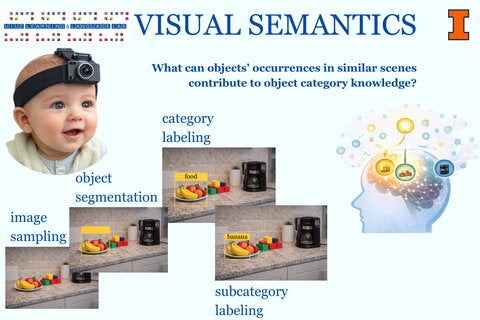
This project investigates how humans learn semantic categories (e.g., food, strawberry, appliance, fridge) from visual experience. Drawing inspiration from distributional approaches to language learning, we examine how objects tend to occur in the naturalistic, first-person experience of infants. The long-term goal is to better understand the ways in which everyday visual input contributes to the emergence of structured conceptual knowledge.
Undergraduate research assistants will work in the lab on image labeling, helping build large, carefully curated datasets of object categorization. Specifically, students will label object instances in images and assign them to superordinate and subordinate semantic categories following a shared annotation scheme. No prior experience with image annotation or computational modeling is required. All training will be provided.
This position is best suited for students who are detail-oriented, comfortable working with visual data, and interested in cognitive psychology, perception, language, or computational approaches to cognition. Students will gain hands-on experience contributing to an active research project and will be trained in the theoretical motivations behind the annotation work.
The position will be open to applications from February 20th to March 3rd. Applications will be reviewed on a rolling basis, and all applicants will have been notified by email by March 10th.
Students can earn PSYC 290 course credit for their work in the lab or choose to apply as a volunteer. Applicants should be willing to commit to working on the project at least 9 hrs per week for at least 2 semesters (or 1 semester + summer).
To apply, please send an email to Rojda Ozcan with a completed copy of the application form, available under the name Psych 290 Information Form here.
Looking forward to your applications!