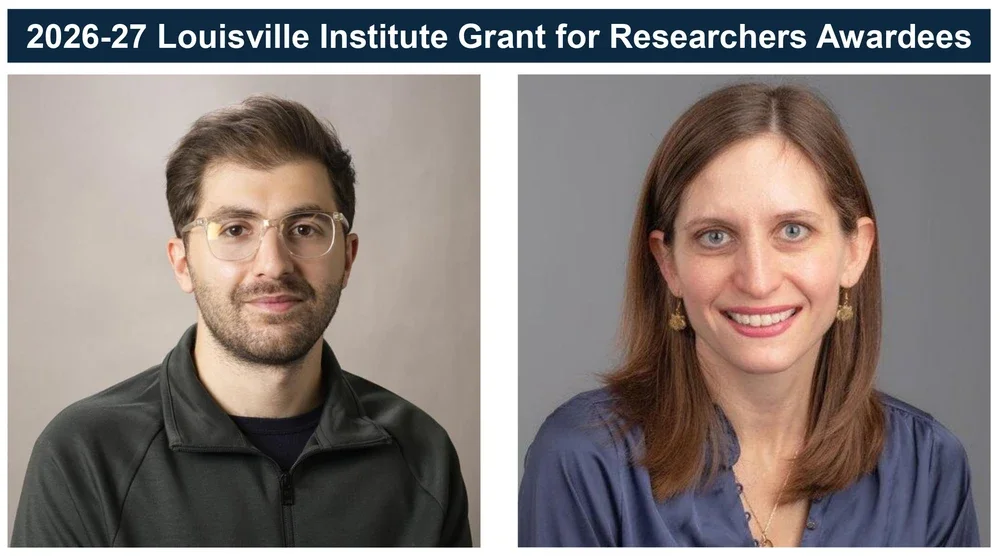
Professor Kimberly Rios and doctoral candidate Mazyar Bagherian have received the 2026-27 Louisville Institute's Grant for Researchers. This $55,000 award supports scholars and researchers across a range of disciplines who are engaged in work that advances understanding of American Christianity. Their proposal, titled "Bridging Science and Faith: A Socio-Cognitive Approach to Increasing Christians' Representation in Science," was chosen for funding among 238 proposals.
Could you provide some background on the motivation behind this project? What inspired you to take it on?
The project builds on Dr. Rios and other scholars’ previous findings that Christians are underrepresented in scientific fields (and academia more broadly). Two psychological explanations have been proposed for this under-representation: (1) compared to other religious and non-religious groups in the U.S., Christians perceive greater conflict between their religious beliefs and science; and (2) even when they do not perceive such conflict, they may still feel unwelcome in science because the dominant group in these fields (e.g., non-religious individuals, particularly atheists) tends to perceive them as close-minded, unscientific, and generally not well-suited for science. Notably, these perceptions are not observed in East Asian and Middle Eastern (Muslim-majority) countries. Our personal experiences with both types of cultural contexts—those in which such conflict is perceived and those in which it is not—inspired us to study this topic. In this project, we aim to understand why this difference exists and how this understanding can be used to address the underlying causes of this under-representation.
What do you consider to be the most significant or impactful aspect of this project for the field of psychology or the university community?
The ultimate goal of this project is to address the issue mentioned above (Christians’ under-representation in science). We hope that our research will equip us to develop guidelines that can be implemented at both university and community levels to increase Christians’ willingness to engage in science and to reduce dominant group members’ predispositions toward Christians.
How does this project align with the Department of Psychology's or the university's broader goals, values, or strategic initiatives?
This project directly aligns with the Department of Psychology’s broader goals and values related to diversity, equity, and inclusion. For us, diversity is a broad construct that includes not only race, ethnicity, and gender, but also religion and other forms of social identity. We believe that diversity in beliefs and ideologies within science is essential for fostering public trust in scientific findings across various domains (e.g., vaccines).
Is there anyone you would like to acknowledge for their contributions to this project?
We would like to thank Dr. Dov Cohen and Dr. Adam Cohen for their support along the road.